Monday, 5 March 2012

A Diamond in Disguise

In the end, it wasn't the small thing I did by taking Claire to the cinema that counted. Not in the least, even if that was how it started....

It was all the amazing and wonderful things that she taught me in the nine years that we were friends. It started as 'just some voluntary work', and turned into one of the most incredible, cherished experiences of my life.

Claire taught me about honesty, about being yourself (unashamedly), about being in touch with the how she really felt (even on days she cried with sadness). She taught me by example how to sing along with gusto and enthusiasm at the cinema and not give a damn what anyone thought; and to love pink and never even contemplate that there could be such as thing as "too much pink". In fact I don't think she ever thought that she could have "too much" of anything that made her happy - when we chose perfectly and she loved a film, she wanted to see it again, NOW preferably, but tomorrow would do. And when she didn't like a film, she was equally up front about that too.....

When she told me many years ago that I was her "best friend" she really meant it, and it touched me all the more for the genuine honesty of her words.

Too many people would write off Claire, because of how she looked, not realising that inside was one of the most amazing and precious people I have ever been blessed to meet. I will cherish these memories for the rest of my life. Monday's will always be "Claire's night".

To know that I will never see that smile again breaks my heart.... But I'm glad that my heart is bursting with love for her - she was amazing. Nine years was a long time, but for me, it was still far too short.

If you ever think of volunteering, just know this: it will change and enrich your life in ways you can never imagine. Next time you see someone with Down's Syndrome, look beyond your prejudice and you'll see a diamond in disguise.

I took Claire to the cinema.
She gave me so much more.

Wednesday, 25 May 2011

PowerPoint Slide Design Lesson #4


Your slides are not an all-you-can-eat buffet!

This is a replica of a genuine slide from a recent talk I attended.  The knowledge of the presenter was fantastic, the delivery okay - the presenter closed his eyes when he faced the audience - but the slides....

Each slide was a visual feast -in the style of an "all you can cram onto your plate" buffet, and our eyes definitely overate!

There were too many clashing elements: large uneven boxes with harsh black lines, a mishmash of fonts and tiny, irrelevant images.  And just how many synonyms do you need for Scholarship and Wisdom?


To my mind, all the slide needed to have on it was this.


Then you narrate around the elements, guiding your audience through the cycle.  The presenter clearly knew his stuff, so why he put so much on the slides, I may never know.

Wednesday, 18 May 2011

PowerPoint Slide Design Lesson #3

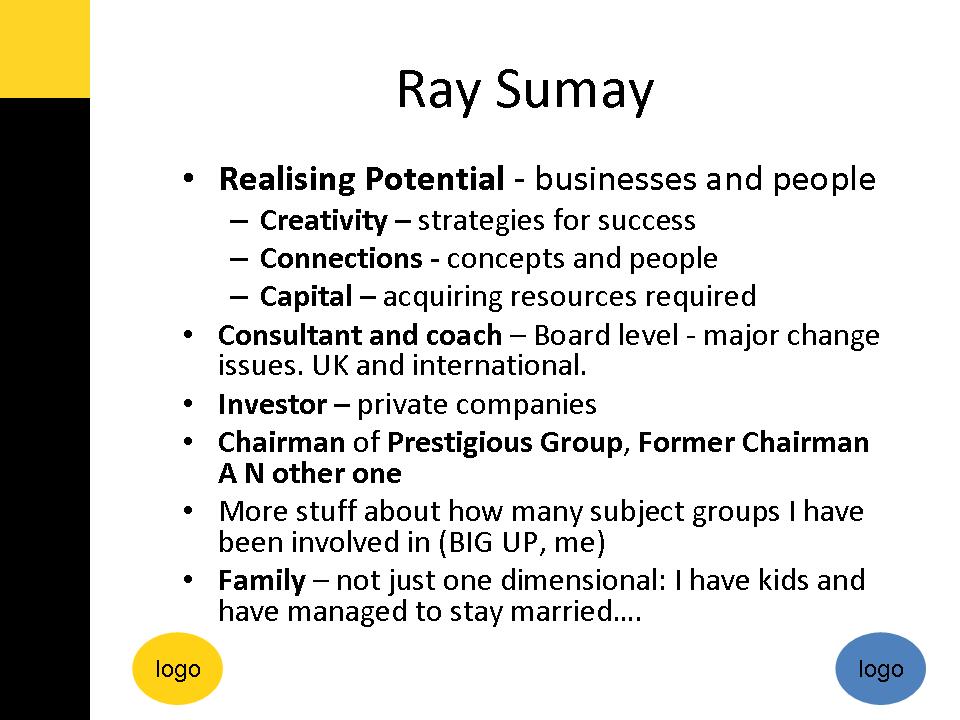
Your slides are not your resume nor your CV. 
Establishing your credibility at a presentation is not about telling them what you have done and how important you are.  Your presentation is not about you at all.

It is all about your audience. 

You will be credible if you
  • connect with your audience
  • demonstrate you understand their needs and their challenges, and 
  • give them practical solutions to their problems.  
Make their life better and you will gain all the credibility and respect that a slide like this simply will not.

this is a genuine example from a recent presentation in the UK by a corporate coach.  I have removed personal details and the corporate logos to maintain their anonymity.

Saturday, 14 May 2011

PowerPoint Slide Design Lesson #2


Your slides are NOT your handouts.

Sure PowerPoint has printing options that let you print 3, 6 or more slides per page of handouts, with or without lines alongside for your learners to make their own notes.

But if your slides contain enough information to be great handouts, then they are lousy slides.

Slides are not written materials - they are not handouts, booklets, or reading matter. They are visual stimulation to add a new communication mode to your oral presentation or narration.

In the opening scenes of a movie, the narrator doesn't describe the scene ("the camera hovers over the roofs of buildings in New York...."). What would be the point?

PowerPoint Slide Design Lesson #1


In a presentations, your slides are NOT your presenters notes - they should not be written to remind you what to say!

If you want to remember what to say...
* learn the story of your presentation
* jot a few reminders on small postcards, just in case you forget
* practise, practise, practise

Keep your slides for powerful images that enhance your narrative and connect with your audience.

Wednesday, 20 April 2011

Playing Pays Dividends on Profits

Easter is just around the corner and the sun is shining - time for some fun and games. Whatever your age, child-like qualities such as a sense of fun and a vivid imagination can not only make your life more enjoyable, they can make your business more profitable too!

Take laughter - adults laugh on average 15 times a day - children do that before breakfast, laughing on average 20 times more often than adults. Laughter is indeed magical - it creates an instant feelgood boost, but has hidden benefits to your health: it strengthens your immune system, lowers blood pressure, stimulates blood flow and boosts cardiovascular fitness.

Whilst laughter and work don't often seem to go hand in hand, perhaps they should....

The Proven Benefits of a Lighter Workplace:

Research has shown that humour and play in the workplace can have a dramatic impact on both people and profits:

* Improved morale
* Improved relationships
* Increased creativity (up to 50% at science giant Monsanto)
* Breakthroughs in productivity
* Increased job satisfaction (and thus reduced staff turnover)
* Better and faster decision-making
* Reduced customer complaints

So today, over Easter and then, hey let's go for it, for the rest of your life, your mission if to be light hearted at work.

To laugh. To share jokes. To dance and sing in the corridor (try it in the loos, it really freaks people out!). To instigate a 'worst holiday photo ever' competition. To have a 3pm dance-off in the elevator. To skip to your next meeting - preferably arm in arm with someone else. To have an impromtu picnic in the park and play frisbee. To go out and buy a round of ice-creams for your team. To prefix everyone's names with King, Queen, Prince or Princess next week in honour of the Royal Wedding.

To find a steep grassy hill and roll down it - it'll take your breath away! To see how giddy you can get on a roundabout looking up at the sky. To stop calling it 'work' and start calling it 'paid-play' - and watch the expressions as you tell people you're off to "paid play" in the morning!

Not enough suggestions? Get out your crayons, sit on the floor and brainstorm some more... or if you're really stuck in the mud visit this website which lists 101 of them...

The question is this - how old would you be, if you didn't know how old you are? Me? Somewhere around 12 and three quarters, going on 21!!!

Monday, 11 April 2011

Vivid Visuals Bring Words to Life

A vivid visual is one of the most powerful and universal means of communicating with impact. Whether it's sharing a photograph of a special event, or explaining how to assemble your flatpack furniture, nothing beats great a picture (or frustrates as much as a bad one!). But instead of just telling you about them, let me help you experience it for yourself....

Think of an elephant.

No, not one like that.

An especially vivid one: a tiny, purple and silver striped elephant, shiny and crinkly, about 2 inches tall and standing in the palm of your hand right now. She's called Betsy and is trumpeting, pa-pah pa-pah as she stomps around in a circle, which kind of tickles your palm a little bit and makes you smile. She keeps looking at your for reassurance - with her deep black eyes and soft eyelashes, and her big ears billowing. How cute is she? Did the image of her make you smile? Did you (almost) hold your hand out to look at her more closely (I did!).

How real is this elephant to you now? When it comes to your brain, the purple Betsy elephant you have imagined is just as real as if she had really been in your hand - you used the same bits of your brain to imagine her as you do to see her for real.

And will you remember her? You bet!

Imagine then, how a few simple words, specifically designed to create clear and vivid pictures can transform the impact you have when you communicate with other people. A few words can literally bring something alive inside their minds.

So before you start crafting a letter, an email, a presentation, decide on the image you want to create in the minds of your audience. And if you can link a number of images to make a story, or movie, even better.

Wednesday, 19 January 2011

The Story of Stuff

Amazing facts that blew me away:
* 99% of things purchased in the USA are trash within 6 months.... 99% !!!!
* it takes 70 dustbins of waste to produce 1 dustbin of household waste....

Watch how some simple graphics, mind-blowing facts and a clear story with action steps create a powerful "story of stuff"....

Hmmm, I feel some decluttering (via freecycle) coming on...

Friday, 17 December 2010

Dear Santa..... My Christmas List for 2010

This year I have been generally good, with a few episodes of overindulgence all to report on the bad girl front. Whilst I know this is the season for giving, could you do some taking instead? If you take a few features in PowerPoint away, you will be giving back thousands, if not millions of hours of life to those who might otherwise suffer from Death by PowerPoint next year. I know they are big asks, but if anyone can do this, you can.

Please, please delete the Word Art function - it's about as clever as writing your name using an etch-a-sketch.

Ditto clipart - those bean men might have seemed clever in the days when an electronic typewriter was the height of fashion, but honestly, have you seen technology nowadays? Would the iPad have clipart?

Please delete the function that lets people print out their PowerPoint slides as handouts - it only panders to lazy presenters and bores us all with prose-ridden slides (when did the "visual" part of a presentation become a page of a book?)

Please also delete all the hideous PowerPoint design templates - which I think is pretty much all of them - a blank white screen is preferable in many cases, especially that one with the annoying ball that moves across the screen for every single bleeding slide.

Please also delete the following functions:
* adding sound effects - unless operated by a skilled sound effects guru
* animating words so that they spiral in front of our eyes - unless part of a Derren Brown hypnosis
* and finally bullet points - nuff said

Thank you very much in anticipation of a much more inspiring year of Presentations.
Yours humbly
Sparkie

I am sure I will think of a few more, but these would make me very happy in 2011.

Thursday, 23 September 2010

The Story Develops for Pecha Kucha Night

Last time I had decided to present on the topic of communication - it's history etc. Pecha Kucha is too fast for a "this is the history of communication" presentation. In putting ideas onto post-it notes, I counted dozens before I have even reached cave paintings.

Tip #1 - Pick a topic small enough to fit into 6 minutes (+) yet with enough substance to satisy your audience

Playing with various ideas involved intense and active pondering - despite outward appearances!

Tip #2 - Try talking off the cuff about your chosen topic and see how much you have to say - time yourself and then work out what to cut out.

After much editing, revising and some practices that helped me learn just how little I can say in 20 seconds (without a machine-gun delivery), I came down to using the Seven Deadly Sins of Presentations.

Tip #3 - Practice the timing after you've done your slides - does the story flow?

For each sin, there is a virtue, so without effort I had 14 topics/ slides at my fingertips. I searched the net and found images of slides, and presenters and some random images to suit the presentation. With a few more hours refining and altering the build-up and finale, it was done (phew!).

Tip #4 - Practice the story - do you stumble over any of your ideas or phrases?

As I did a dry run, the actual names of the sins and virtues was causing me too much anxiety, so after creating the slideshow, I ditched the Sins and changed the title to "Presenter Heroes and Zeroes". Perhaps another night to think would have improved that one!

Tip #5 - Remember, it is only Pecha Kucha night!

Today is the day that I present at Huddersfield Pecha Kucha night #2. Wish me luck!

Wednesday, 15 September 2010

The Art of "Chit Chat" - Pecha Kucha

Pecha Kucha is a time limited format for presentations, with a similar twin in Ignite - each allows just 20 slides, with either 20 (for PK) or 15 (for Ignite) seconds per slide. The talks are therefore either 6min 40 seconds, or 5 minutes dead.

It is fast paced, and fun (I hope!)

And instead of going along to one to see what it's about and gradually building up, I launched myself into the deep end by volunteering to present at the second Huddersfield Pecha Kucha night next week.

This is the one time that I can present on anything. It is not a sales pitch, but an evening of discussion, enlightenment, enjoyment......So I am blessed (or cursed) with total freedom.

Reading up on some advice I came across these nuggets: "it should be about passion" and that if I don't have "too much to say" I had chosen the wrong topic. In clarifying that, this Pecha Kucha presenter suggested that I talk about something I have stayed up late at night arguing or discussing with friends etc.

That got me thinking - learning (which I love)? presentations (my life's work to save the world from Death by PPT)?

Then I thought, let's get back to the real issue - this is all about communication - from cave paintings to PowerPoint, this is all about our desire to understand and be understood.

Now to create a story about that that will take my listeners on an enjoyable and potentially thought-provoking journey.....

Watch this space for how things develop....

Thursday, 9 September 2010

How Enjoyable Should Learning Be?

Watch any episode of Gordon Ramsay's Kitchen Nightmares (where the celebrated chef spends time with a failing restaurant to help them out) and you will observe some of the following stages of learning:

* Unconscious incompetence - the moments before Gordon arrives, when the owner/ chef is looking forward to Gordon "helping them out"
* Conscious incompetence - just after Gordon has sampled their food, when Gordon subtly informs the cook/ manager of how poor their restaurant is (watch their faces as they learn)
* Conscious competence - after days of changing the menu, redecorating as the team puts new ideas/ menus etc into practice successfully (if they get that far)

The final stage is unconscious incompetence, which will happen after Gordon has left (sometimes) - the sort of "do it in your sleep" capability that experts exhibit.

Now any of you who have watched this programme (or others like it) will recognise that few owners find this process either enjoyable or easy in the short term. As Gordon bluntly explains just how bad things are, they quickly reject the painful process of going from where they were to their new level of understanding (going from unconscious to conscious incompetence).

This is the real heart of the programme - the people reject suggestions, they argue that Gordon doesn't know what he is doing, they blame everyone else but their own incompetence. There is anger, tears, trantrums, you name it. What you are watching is the the painful process of learning how much you don't know. They demonstrate just how difficult transformatory learning can actually be.

It is very tempting as a facilitator to ensure that your learners enjoy themselves throughout your workshops/ presentations. Learning can be, and should be in many instances fun. But fun rarely gets your learners leaving their comfort zones (which by definition would be uncomfortable), nor will it transform their attitudes, knowledge or skills.

If you really want to create change, then you have to be prepared for your learners to be uncomfortable, to be challenged, to hear things that are difficult to hear.

If what you design leaves them enjoying their learning too much, they might learn nothing at all.

As William James once said "A great many people think they are thinking when they are just rearranging their prejudices". To me, the word thinking can be replaced with learning to describe that lovely safe learning experience where nothing much changes.

So go on, I dare you.
I dare you to create discomfort in your learners and move them into conscious incompetence.....

Saturday, 24 July 2010

Why Should Your Audience Listen to You?

Everytime you present to an audience, you are entering into a bargain with them - they are swapping their time to listen to what you have to say.

What is it that you have to say that they are going to value?
Do you know what the What's In It For Me (WIIFM) factor is?

Why should they listen to you? Are you going to....
* Save them money?
* Save them time?
* Reduce their stress?
* Make them richer?

I was working with a fantastic coach, with a great product and she wanted market her programme to potential clients using some free presentations. Her working title was "Time Management" but it had no WOW, no promise, no WIIFM. By the end of our session, she got crystal clear on the benefit to her audience - and decided to promise that she could save her audience an hour of time every day if they used these techniques.

That is some WIIFM factor!
Would you spend a few hours listening to a presenter who can save you an hour every day of the week?

Think about this when you are designing your presentations - why should your audience listen to you?

Wednesday, 14 July 2010

Selecting Images that Speak to Your Audience

This week I've been creating a very 'Zen' style presentation on the topic of Parent Advocacy.

I love 'Zen' design and my slides were looking good.....
  • Simple.

  • Stylish.

  • Strong beautiful images.

  • Powerful phrases.

I was feeling pretty chuffed with myself until I noticed one thing.....

I had tin cans connected with string for communication.
A power of books for information and advice
A megaphone for parent voice.

But not as single picture of either a parent or a child.

This entire presentation is based on reminding parents how important they are, and how we want to give them a new voice in our region. How could I have missed that?

A few minutes later and the revised version is much stronger - showing images we have taken at our events, and people (young and old) my audience will relate to.

Now, all the powerful phrases such as "Giving Parents a Voice" are next to images of a parent holding a microphone.

I put the audience in the picture, so to speak!

Tuesday, 20 April 2010

Start A Conversation

Presenting is no more difficult than having a conversation. You simply open your mouth and talk- something most of us do every day with ease.

Ask someone for a natter over tea and they rarely break out into a cold sweat the way they might if you asked them to present for a few minutes at the next team meeting.

Why?
It's not physically difficult - it's only as hard as talking.
It is our mind that tricks us into thinking it's difficult.

Our mind plays out disaster scenarios of tumbling over simple words - words we say faultlessly everyday- of embarrassing ourselves, of not knowing what to say.

Our thoughts create uncertainty in our mind - an uncertainty not present in water cooler chats.
Uncertainty breeds nerves and suddenly a simple act of talking becomes the momentus task of presenting.

The nerves tell us it's a big deal and stop us having a simple conversation with just a few more people listening in.

Instead of presenting to crowd, start to think in terms of conversations- with friendly people you like, where a few people (even a few hundred people) just happen to over hear it. Be your normal, charming, funny self.

No over exaggerated stage persona required.
Try it, you never know how the conversation will end.

Say What You Need to Say

"Nobody cares if you can't present well. Just get up and present. Great presenters are not great because of their technique, they are great because of their passion!" ~after Martha Graham

Martha's quotation was about dancers, but the same thing applies whether its painting, science, yoga, cooking or presenting.

The message is simply to start.

All too often we let our need to be perfect get in the way - we wait until we are sure, or ready, or some such thing that is far away....

Don't expect to be the best presenter in the world straight away - just get in touch with the passion you feel; the words and skills and knowledge you yearn to share with the world, and get out there and share.

Share it because people need to hear it.
Share it because you need to say it.
Share it because someone needs to hear you say it in order to really hear it.

Start NOW: book a room, phone someone and offer to speak for free. Just get out there and share. You might just find you fall in love with it!

Sunday, 28 March 2010

Storytelling - Words, Song and Dance

When you are getting ready to deliver a workshop, a lecture or a presentation, what do you spend the most time preparing?

Chances are you spend the most time preparing what you are going to say. In fact, apart from your slides and handouts, which are just notes to enhance or supplement what you are going to say, many of us spend 100% of our time on this aspect of our presentations.

Yet a huge percentage of our message and our impact comes from not WHAT we say, but HOW we say it - our body language, and our tone.

Great storytellers practice their delivery in detail:
* where and how long to pause
* words to stress
* phrases or elements that are whispered, shouted, or just said
* when it is appropriate to add physical movements or acting to draw the audience in
* when to use facial expressions to enhance the story

Not only that, but a story teller is acutely aware of their audience and uses feedback to modify their story telling. So why not think like a storyteller for your next presentation and spend a little more time on HOW you deliver it, as well as WHAT you will say?

Monday, 22 March 2010

Curiosity Might Have Killed the Cat....

But it is without doubt one of the most important states that you can create in your audience before any sort of training, meeting, presentation or event.

How do you create curiosity?
I'll tell you in my next post............

Wednesday, 10 March 2010

Do the Opposite of What They Expect!

Today I saw a wonderful article on a children's art programme - all about Green Graffiti - where an artist sandblasts a dirty wall (in this case at Brighton's marina) using some templates to create a work of art. The shapes are formed from "clean wall" against the lichen, moss and dirt of the wall.

What a genuinely novel idea - a wonderful example of reversing ideas and coming up with something better..... Burnley has also reversed ideas about art - by creating works of art called Invisible that magically comes alive in the dark, as it is painted in UV paint.

It is the same for presenters and trainers - the very people you wish to engage and inspire have probably seen and been to dozens of presentations and training events. It all becomes rather predictable - been there, done that, got the t-shirt.

So how do you get their attention?
How do you make them curious?

Simple - do something different.

I can remember the excitement and curiosity when I brought a room full of trainers into a room that was pitch dark, using torches to light their way. It was eight o'clock in the evening after a full day's work and they were at an evening class - tired and just dying to go home. But the dark signalled that something different was about to happen and they perked up brilliantly.

Think of the "norms" and turn them upsidedown:
* If they are expecting 127 PowerPoint slides, give them none.
* Instead of sending them an invite - send them a puzzle to solve
* Instead of starting off with an energiser - give them a really difficult task to solve
* Instead of giving out handouts - get them to write they key points on a credit card sized piece of paper and laminate it as a ready reminder
* Instead of using a happy sheet - get them to design a quiz to test their own knowledge at the end of the day and use a "runaround" quiz to explore what they are thinking and feeling

Today - think of just one thing that you "normally do" during your presentation or training, and then think of the opposite. Then work out how that might work to grab your audience's attention and engage their hearts and minds.

Monday, 5 October 2009

Watch Your Attitude as You Train or Teach - Believe!

This is an amazing, emotion, powerful, inspirational appeal to anyone who works with other people....

Dalton reminds us about how much we work together to make a difference to the young people in our communities. But the message works for all organisations, all people, all companies.

Perhaps it's time to consider how often we ask ourselves what we are passing onto the next generation.

Do we believe that every person we teach can reach their potential? Because ultimately it is in our hands and minds to make that happen.